
Click on the video links below to check out the Ojeda studio in San Martin Tilcajete, where I will be studying for the next 5 days.
Ojeda workshop, carving copal wood
Detail painting of Zapotec patterns
Maria Angeles Ojeda, master artisan, explains the different animals in the Zapotec calendar
This marks the end of my first two weeks here in beautiful Oaxaca, and I am beginning to feel a bit disillusioned.
On Wednesday night, Tia (the artist-in-residence here from New Zealand) had her art opening at a nearby gallery called Proyecto Chicatana run by Cesar Chavez – a prominent printmaker here in Oaxaca. This guy is the man. His work is incredible. It’s very raw, morbid, funny, and relevant, and can be viewed here. Turns out, Cesar was recently at Kutztown University, and worked with Kevin McCloskey – Dan McCloskey’s dad – while he was there, doing workshops, exhibitions, etc. The KU article can be read here. What a small world this is!
Anyways, Tia’s show was great. The statement for her show was: ”The collection of my recent pieces explore the boundaries of conventional needle work practice through investigating the complex associations we have with human hair.” Her stuff is rad. She had numerous works on display, including intricate embroidery into matted human hair, a broken ceramic baby doll painted blue, and a bunch of chicken feet with fire engine red fingernails! Check out her website!
It was fun to go out with the Arquetopia gang and meet some local artists. I felt at home among people my age who have similar interests and who like to party. I have to admit, I miss that lifestyle a lot. After the show closed up, we brought over the extra mezcal to one of the guy’s houses up the block and had a little show. We played pots and pans in the kitchen while Julio (another young artist in Oaxaca) and Cesar free styled and played guitar. All around, people were just chilling, smoking and drinking 40s. It reminded me of Pittsburgh, and the waves of nostalgia started pouring over me. I miss my friends. I miss what they do. I miss being a part of the culture instead of just an admirer. I feel like a bystander here, witnessing so much beauty and wonder that I am overwhelmed by it. This is almost paralyzing to me.
Back in reality, we were all having a good time, but the owner of the house mentioned that his neighbors complain a lot. We took the party down the road to Fandango, the bar next door to our house. It was just as grimy as I expected it to be, but yet again, it reminded me of someplace I’d go drink in Pittsburgh. It was full of crust punx and the occasional mildly slutty goth chick. Feels like home! After some time at the Fandango, we went to Txalaparta, the cool club that hosted the Film Fest after party. It was fun, and it felt great to get out and experience the nightlife with a blend of friends and strangers.
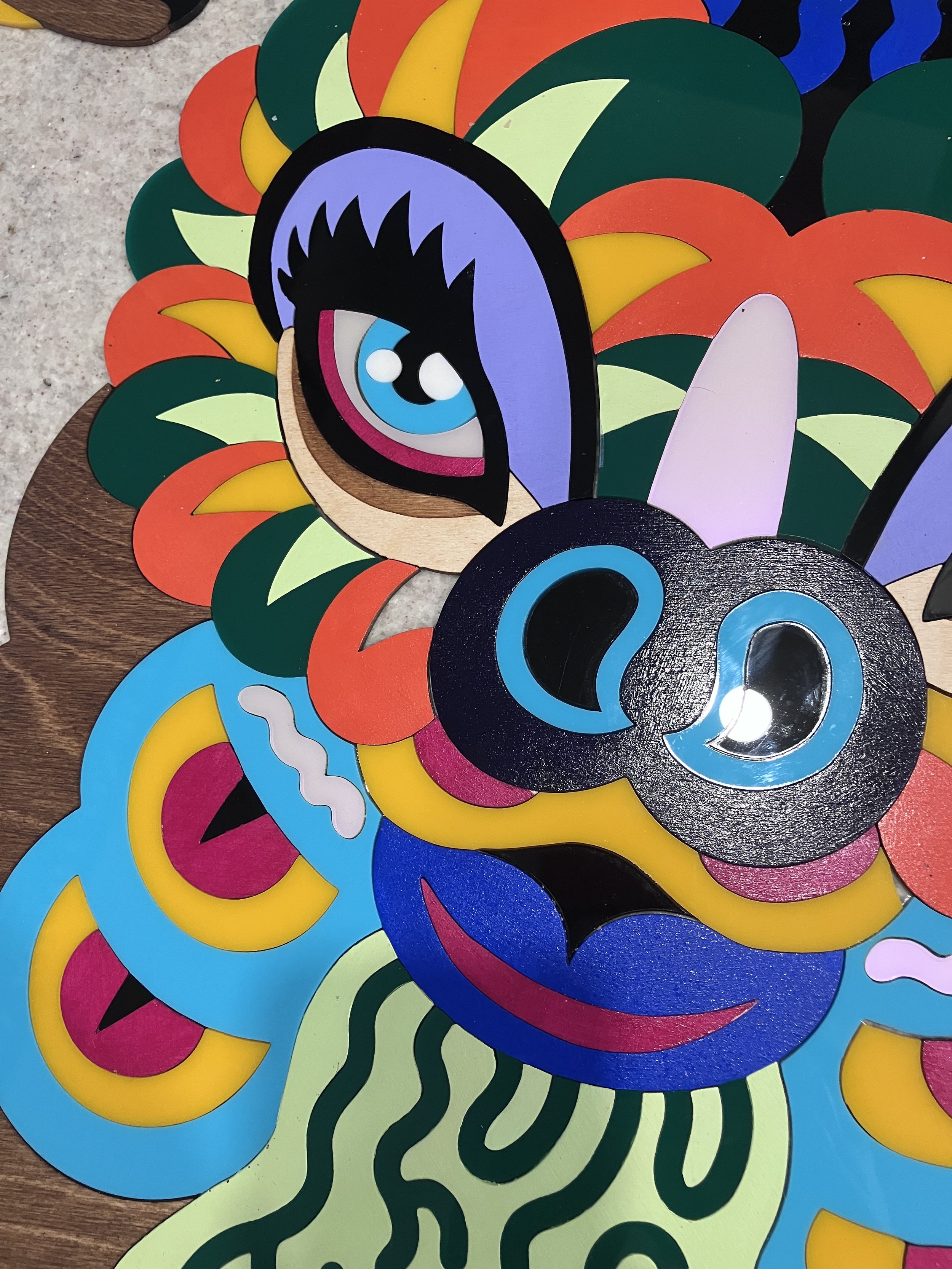
The next day, Lazaro, Marty and I went to San Martin Tilcajete – the other wood carving village here in the Oaxaca Valley. Albeit short, it turned out to be an incredible trip. We visited the studio of Jacobo and Maria Angeles Ojeda who are two of the most prominent artisans in Mexico. They are internationally recognized for their work, and especially for the intricate Zapotec patterns that are painted on their larger work in natural pigment colors.
When we arrived, we were warmly greeted by Maria Angeles herself, and given a tour by a carver who works there. He guided us through the process of cultivating the copal tree (which they consider extremely important in preserving the tradition of alebrije carving in the region), carving with a machete and kitchen knives, drying, sanding, mixing natural pigment paint, painting, and selling. There were at least 20 people working throughout the large workshop, most of whom were women and young men painting. Most were painting with synthetic acrylic paints, while others were pouring over detail with handmade natural pigment paints that our guide also demonstrated to us.
The attention to detail was incredible. It looked as if a machine had done the work. Our guide explained that every pattern has a significance in Zapotec culture, and correlates to its calendar (similar to the Aztec and Mayan calendars). On average it takes a month and a half to finish painting a figure in this way. Only the highest-quality and most expensive pieces (usually carved by the master himself, Jacobo) are painted like this. The majority of the pieces produced at this studio are done in synthetic paints, and in turn, sold at a lower price.
After our tour, we were chatting with Maria Angeles and our guide in the gallery area, and I asked if I could buy some copal from them to work on. The cedar I bought is much too hard for my dull-ass machete to slice through, and I’ve only achieved blisters on my hands from trying. The guide said that if was interested, I could take a class at the workshop to learn how to carve. My eyes lit up and I smiled widely. Yes yes yes yes yes, I am interested, I told him. He gave me his card, and I emailed them the minute I got back to the house to eat lunch. They got back to me right away, and said that I could take a 5-day course from 10 AM to 2 PM this coming Monday thru Friday for $250 pesos each day. This equates to a little over $100 USD for the whole week. They will provide the wood and tools, and they said they would even sharpen my machete for me! I was so thrilled to make this arrangement – I’m finally doing what I set out to do here.
Friday, Lazaro, Greer, Alex, Andrea and I visited a cochinilla (cochineal) farm. Cochinilla are tiny, sessile, parasitic insects that live in the paddles of Nopal cacti. These insects produce an abundance of carminic acid to protect them from predators. Carminic acid is what produces the vibrant red color that the cochinilla are harvested for natural dye for food, cosmetics, and textiles. The farm had thousands of paddles – ready for cochinilla to infest. The paddles are removed from the mother cactus, stuck in a planter, and then infested with cochinilla. The larger, mature females bury themselves in the cactus and secrete a white, chalky substance to protect from the sun and predators. The males are much smaller, and have wings. The insemination happens in what is called Zapotec nests which look like Chinese finger puzzles. They are placed on the top of the cactus, and clean females are placed in there to await getting knocked up. What is actually valuable are the large, mature females that bury themselves in the cactus to feed. Once the Nopal paddle is saturated with females, the farmer brushes them off into a mesh box, cleans them, then grinds them to a pulp using a mortar and pestle to produce red powder. This powder is then combined with other things to create various types of dye. Now that people are realizing that alizarin and other synthetic red dyes can be carcinogenic, the cochinilla are valuable again.
Yesterday, I went to Arrazola by myself to check out the smaller studios that I missed on my last two visits. I didn’t see Oscar this time, so I wandered up Calle Emiliano Zapata. It seemed like every house was a studio, door open, alebrijes on shelves, man carving, woman or child painting, and people standing outside telling me to come in. I visited several families like this, all of which were wonderful people, and many of whom are related to the Jimenez dynasty either through blood or through law. One of my first stops was the studio of Armando Jimenez and Antonia Carrillo Jimenez. Armando is the grandchild of Don Manuel, and Antonia is the sister of Nicolasa – the wife of Isaias Jimenez. Armando was out of town doing two exhibitions in the US (NY and LA), so Antonia was at the house with her 15-year old son Alejandro and her 5-year old daughter. Most of their work was also with Armando (40 pieces for each show, so 80 in total!), but there were a couple of works on display, as well as a large photo album of work and demonstrations that they have done in the US and in Mexico. Antonia was one of the nicest people I have met here. She told me to come back anytime, and that when her husband gets back on the 3rd of December, he will teach me some things. She also gave me three pieces of copal wood that Alejandro chopped off for me with a machete. I offered to pay her, but she politely refused. One of the pieces was the highly coveted copal verde, or wet copal, which is much easier for carving.
I also visited a woman named Floriberta, who sold vibrant and comical alebrijes out of a one-room house. Characteristically, her husband carves them and she and the girls in the family paint them. I bought a piece from her at a very good price, and I asked her if she would write her name for me. She told me, “I can’t write.” Here is this woman, probably in her 60s or 70s who has mastered the art of detail painting, color, and line for the majority of her life, who never learned to write. That will stick with me.
One of the final stops, after several beautiful and amazing other stops, was a couple who founded an organization called EcoAlebrijes. Their mission statement is as follows: “The SJSU-Ecoalebrijes Intercambio is a unique partnership between the Health Science Department at San Jose State University in California and the EcoAlebrijes Association of Arrazola in the southern Mexican state of Oaxaca. State-of-the-art technology, inspired by the artisans and organized by the students, invites you to explore the beautiful art of the alebrije, learn about the environmental sustainability projects of the Oaxacan partners, and to find out more about the artisan association.” The couple who runs it are from Arrazola, and they make beautiful work. They use a very unique color palette that was different from the other styles of alebrijes the I’ve seen thus far. The craftsmanship was outstanding, and the couple themselves were very kind and proud of the work that they do.
It can be tough, this whole art making thing in a different country. The people whose work I admire have been practicing since they were children. I am either too weak or I don’t have the correct tools necessary to make the beautiful work that they make. Despite the setbacks I’ve had, I’ve been very lucky too. I’m lucky to be here, and I am having a great time. While I do get lonely, especially now that the residency house is nearly cleared out, it’s important for me to be here. Thanks for supporting me in this wild adventure, and I truly cannot wait to come home.


Hi Lizzie, found this story interesting, but it wasn’t clear to me if the outfit you are disillusioned with is Artquetopia. I had wondered about them. Anyhow, I agree Cesar is the man, it would be great to print some of his images in a zine in Gringolandia. Thanks for lining back to my blog and Keep cartooning!